AI Whiplash: How to Tell Which Future We're Heading For
Dev team: "We'd like to use [open source model] for our new Special Project."
Review committee: "Please fill out this form."
...
Review committee: "Wait, where is this model from?"
Dev team: "It is a state-of-the-art model for our narrow use case from [foreign country lab]. We can host it on our Azure infra. It'll be sandboxed."
Review committee: "Rejected. Please use more expensive [inferior closed model] from Big Vendor."
This is paraphrased, of course, but is a real story from this year. The client's review committee had valid reasons for going with the more expensive Big Vendor, including pre-existing enterprise agreements, fully managed infra, turnkey IdP integration, etc. Time will tell if this was the right long-term call, but this is just one example of the sort of AI adoption hurdles that the industry is facing.
It's a whiplash-inducing time to be working in the software industry. You have brilliant minds at the frontier developing a 17-million-line proof of the Riemann hypothesis with the help of AI, while the same lab's model also deleted a professor's syllabus during a page-number edit. You have companies pushing for large amounts of AI spend per developer, while others place strict limits on usage. You have some developers building software factories and shipping more code than ever, and other developers having to submit a ticket to ask IT to let their agent read framework docs from the internet. True story.
I've been running into these types of friction while trying to integrate AI solutions at conservative enterprises. But it's easy to criticize and assume slow adopters (who in most cases have very valid reasons for being cautious) will get left behind, or to cop out entirely with "well duh AI will diffuse unevenly". There are real hurdles to broad adoption of AI across the economy, especially in regulated industries, but at the same time the frontier keeps advancing at a ridiculous pace, with some signs of recursive self-improvement. It's hard enough to know where we are, let alone where we are headed as frontier capabilities expand and AI permeates more and more industries.
We can't predict what will happen. But I think most of it comes down to one driver and two conditions, and how they combine tells you a lot about which future we're heading for. The capabilities demonstrated at the frontier labs can be thought of as a "preview", and how fast these capabilities grow is the driver. The first condition is commoditization, whether frontier capability is widely obtainable or controlled by a few. The second condition is diffusion, or how fast obtainable capability actually gets put to use.
All models are wrong, but some are useful
Like all models, this one is necessarily wrong, but hopefully useful. I've been asked a number of times over the past few months what to make of the incredible advances in the frontier models, with folks' perceptions varying from "Skynet", to "progress and prosperity", to "meh, AI is normal technology", and even some skeptics of the value of the technology at all. So I thought I would write down some thoughts on how I've been grappling with the pace of progress and all the contradicting claims flying around.
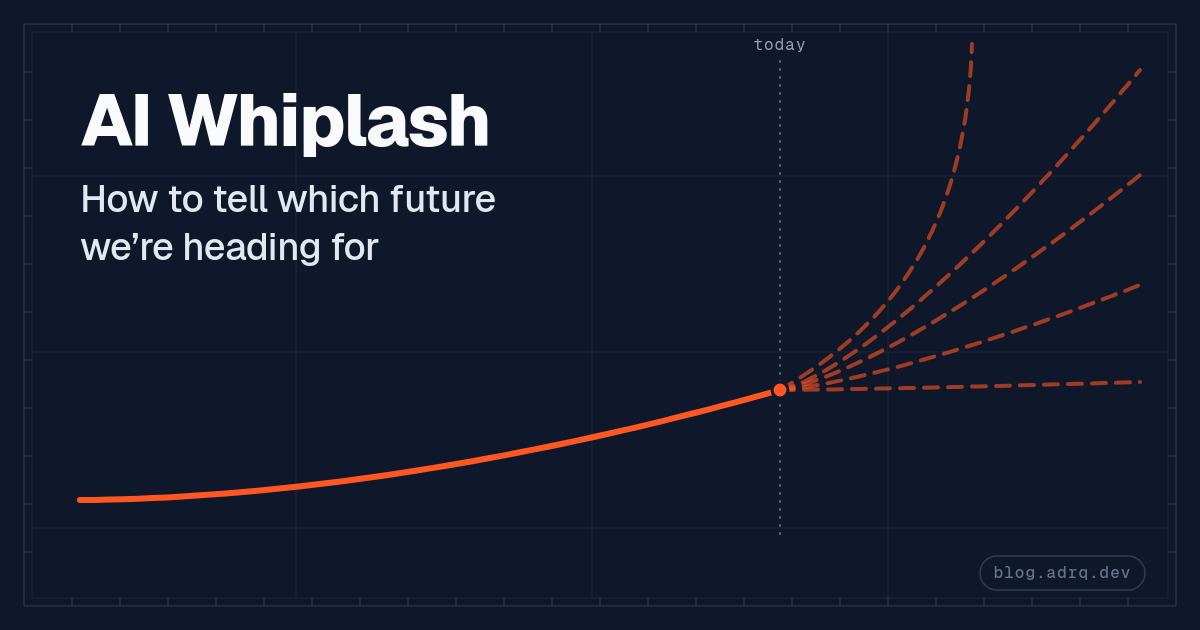
Capability growth at the frontier is the driver. It sets the ceiling for everything else. By capability I mean the set of tasks that someone has demonstrated can be done with AI at a particular level. This set keeps on growing and may lead to recursive self-improvement at a frontier lab. But this could also stall, or make slow progress for a long time and then jump all at once. Unfortunately for most of us, this is hard to see from outside. What we can observe is what gets released and sold, and from that we can make our own inferences. The rate of growth determines, in large part, how extreme the outcomes might be compared to a baseline.
But the outcomes are not determined only by the pace at the frontier. We also need to look at commoditization. In this context, commoditization means that you can get near-frontier capability from plenty of places, they're more or less interchangeable, and prices keep falling. Nobody gets to be the gatekeeper. A bit of nuance here though, falling prices by themselves are not a sign of commoditization as long as the frontier and near-frontier capabilities are concentrated in one or a few providers. Likewise, wide availability alone is not commoditization if prices stay out of reach for most. Commoditization determines what capability is realistically obtainable.
Similarly, obtainable capability doesn't tell you the rate of diffusion. Diffusion means how fast an obtainable capability is allowed to be put to use and actually implemented across organizations and industries. This is determined by those on the receiving end: your regulator, your IT department, your boss, the review committee telling you that you can't use the state-of-the-art model.
This is another one that's hard to observe, because we tend to focus on our own industry or organization. But we can look at a couple of dimensions to get a better sense of where things might be. One is cost and effort: integration, wiring this stuff up, and evaluating results take real work. The other is authorization: are the people in positions of authority allowing the use of the capabilities?
Putting it all together
| Commoditization and diffusion | Capability growth | ||
|---|---|---|---|
| Stall | Steady | Accelerate | |
| Commoditized, fast diffusion | The tools stop improving and everybody has them. They become infrastructure, like databases. What you build is what counts. | Each improvement reaches most organizations within months and gets used. Know what to point it at. | Capability arrives faster than organizations can absorb it, and it is open to all. Move quickly or be passed. |
| Commoditized, slow diffusion | Good-enough tools spread at the pace of earlier technologies. You have time. | The "normal technology" world. Tools keep getting better and cheaper while institutions take years to use them. Getting it adopted is the job. | Far more is possible than is in use, and the gap keeps growing. Unchanged does not mean safe. |
| Concentrated, fast diffusion | A few suppliers hold a lead while the frontier stands still. Open alternatives catch up unless something other than the model keeps them out: compute, distribution or regulation. You are a customer. | With each generation the best is theirs first, and you depend on it a little more. You are a tenant. | One or two labs pull away, and the rest of the economy runs on what they choose to sell. You are a serf. |
| Concentrated, slow diffusion | The best capability is rationed and not improving. That is hard to sustain: with the frontier standing still, alternatives catch up. It will not last. | The best is rationed and most workplaces look the same. Access is the advantage. | Remarkable results inside the labs, little reaching outside. Watch who gets access. |
Where are we today?
This is my perspective as of late November 2026
- Capability: Accelerating. Less clear on how far ahead unreleased models are.
- Commoditization: The near-frontier is commoditizing, but a handful of labs still hold a clear lead in capabilities. Keeping an eye on the gap between publicly available closed models and the best open source models.
- Diffusion: Lots of people have tried AI, but few enterprises have really changed how they work. Software development is ahead in terms of adoption, and software that uses AI is working its way through the corporate world, subject to the usual enterprise constraints.
- Where that puts us: Accelerate column, and where we end up depends on 1) whether one or two labs manage to pull away and 2) how quickly the economy integrates the new capabilities.
- What would change my mind:
- A runaway lab in terms of capability
- Open source models reaching parity with publicly available closed frontier models
- A year of new releases without step improvements in capability
- Seeing conservative enterprises or industries outside of software rapidly reorganizing
I'll revisit this when one of these happens.